Polestar Reveals Full Carbon Footprint of Polestar 5 in Transparency Push
The Swedish EV brand said the four-door electric GT has a cradle-to-gate carbon footprint of 23.8 tons of CO₂ equivalent, covering emissions from raw material extraction through production and delivery to customers.

Polestar has released the full life cycle carbon footprint of the upcoming Polestar 5, continuing its push for greater transparency in vehicle manufacturing emissions. The Swedish EV brand said the four-door electric GT has a cradle-to-gate carbon footprint of 23.8 tons of CO₂ equivalent, covering emissions from raw material extraction through production and delivery to customers.
The announcement expands Polestar’s sustainability reporting effort, making it the first automaker to publicly publish life cycle assessments (LCAs) for every vehicle in its lineup.
Polestar publishes full carbon footprint for new Polestar 5
The life cycle assessment shows that the 23.8 tCO₂e footprint for the Polestar 5 includes emissions tied to materials sourcing, manufacturing processes, and logistics up to vehicle delivery.
A key factor in reducing emissions came from Polestar’s aluminum sourcing strategy. Aluminum is typically one of the most carbon-intensive materials used in vehicle production, but the company said it significantly lowered emissions by using recycled aluminum and smelters powered by renewable electricity.
According to Polestar’s press release, 13% of the aluminum used in the Polestar 5 is recycled, while 83% comes from smelters running on renewable power. That approach avoided roughly 14 tons of CO₂ emissions per vehicle compared with traditional aluminum sourcing methods.
Fredrika Klarén, Polestar’s head of sustainability, said transparency around emissions is essential for reducing the environmental impact of vehicle manufacturing.
“You cannot reduce what you don’t measure. Making the carbon footprint of a car visible helps focus the industry on where emissions occur, particularly in materials and manufacturing,” Klarén said.
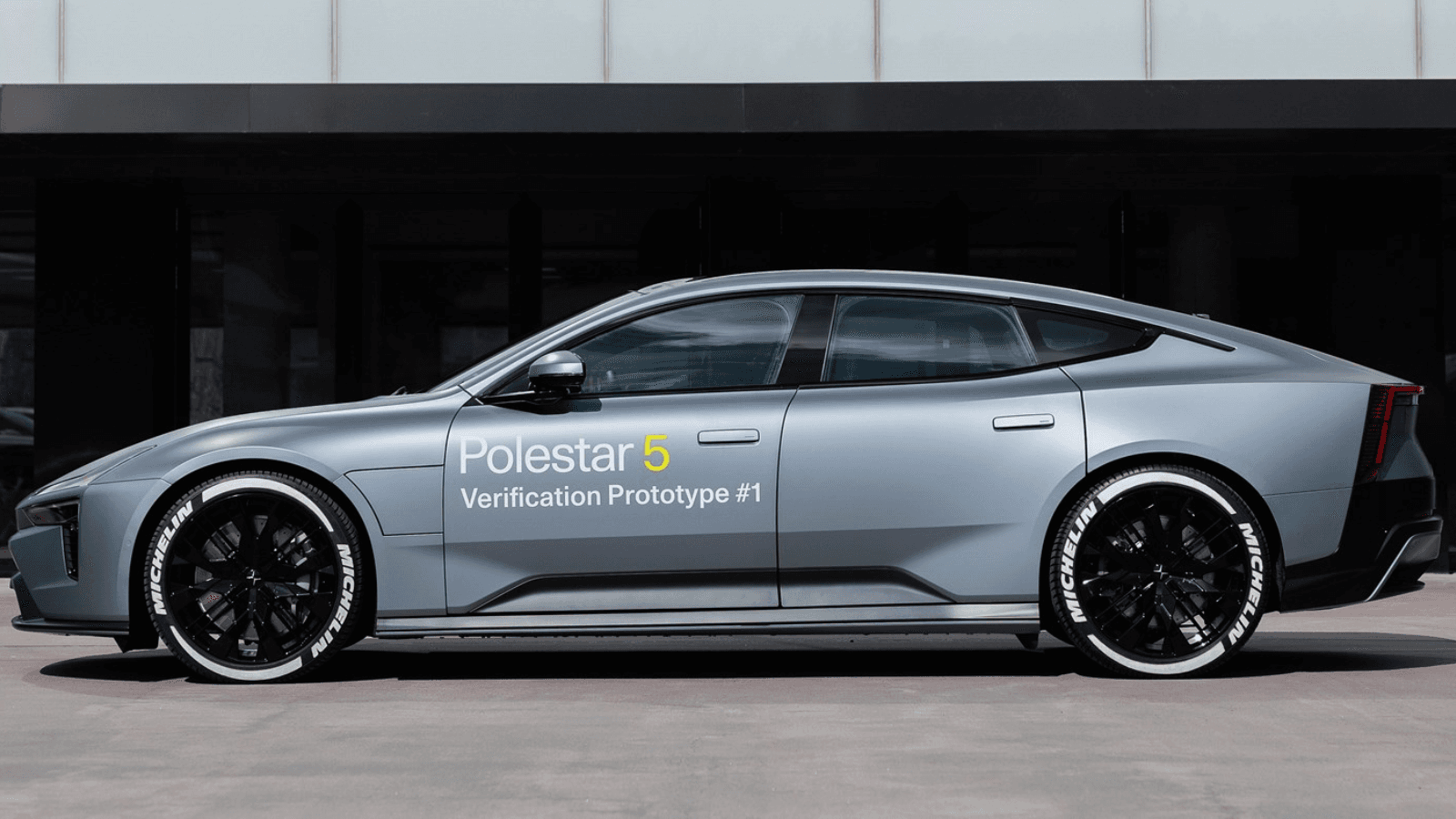
Renewable energy and recycled materials reduce production impact
Polestar said renewable electricity also plays a major role in manufacturing the vehicle. Production facilities involved in building the Polestar 5—including plants producing battery cell modules and key battery materials—operate using renewable power.
The company has also incorporated lower-impact materials throughout the vehicle’s interior. These include flax-based natural fiber composites developed with Bcomp, which serve as a bio-based alternative to carbon fiber and use about 50% less fossil-based material while reducing weight compared with traditional plastic composites.
Additional recycled materials are used inside the vehicle, including Econyl carpets made from recycled fishing nets and PET-based textiles. The front trunk also features a mono-material recycled PET construction designed to improve recyclability at the end of the vehicle’s life cycle.
Despite its sustainability focus, the Polestar 5 remains positioned as a high-performance EV. The four-door GT is expected to deliver up to 650 kW (884 horsepower) and 664 lb-ft of torque, with an estimated 678 km WLTP driving range. Its 800-volt architecture and 350 kW fast charging capability allow the battery to charge from 10% to 80% in about 22 minutes.
EV.com tracks the evolving EV collector space and performance electric vehicles hitting the market. Explore our listings to find the best EVs in your area available today.
Comments
Categories
Related news



Subscribe for EV News and Reviews

AI Employee for Car Dealerships
Results in 30 days - Or We'll Give You Your Money Back